CM Punjab Free Solar Panel Scheme 2026: Complete Guide
The Government of Punjab has launched a free solar panel distribution programme aimed at low-income households across the province. It’s part of the broader Roshan Gharana initiative, also known as the Chief Minister Solar Programme.
The idea is simple: give small solar kits to the households with the lowest electricity consumption so they can cut or eliminate their monthly bills. Phase 1 targets more than 100,000 households.
Here’s what you need to know — who qualifies, what you get, how to apply, and where the scheme falls short.
Latest Status & Next Phase
Last updated: June 2026.
The scheme remains an active 2026 initiative. Phase 1 targets over 100,000 of the province’s lowest-consumption households (0–200 units per month). Systems are allocated by ballot and rolled out district by district, so selection is staggered rather than immediate — further phases are expected to widen coverage.
Is the scheme still running in 2026? Yes, it’s a phased programme. Eligible low-income households — with a Punjab CNIC, an active DISCO connection, sanctioned load under 2kW, and 0–200 units of monthly consumption — register through the official Punjab government portal. Because rollout happens by ballot, check the portal for the current registration window and your application status before applying.
Who this isn’t for: if your monthly bill exceeds Rs. 5,000, the free 550W–1,100W kit wasn’t designed for you. It runs a few fans and lights — not air conditioning, refrigeration, or water pumps. Households consuming 500–800 units per month need a net-metered 5kW–10kW system to meaningfully reduce their bill. More on that below.
Eligibility Criteria
The scheme has strict requirements, checked automatically when you apply through the government portal.
- Punjab residency — valid CNIC reflecting a Punjab address
- Monthly consumption of 0–200 units — higher consumption disqualifies you
- Connected load under 2kW — your sanctioned DISCO load must be below this threshold
- Active electricity connection — with LESCO, MEPCO, FESCO, GEPCO, or PESCO
- One system per household per CNIC — duplicate applications are flagged and rejected
If your bill puts you in the 200+ unit range, you won’t qualify. The scheme targets the lowest consumption tier only.
What You Receive
The government offers two system tiers based on consumption bracket.
Tier 1: 550W Solar Panel System For the lowest consumption bracket. Includes a single 550W panel, a small inverter, and basic wiring — enough for a few fans and lights during daylight hours.
Tier 2: 1,100W Solar Panel System For households slightly higher in the eligible range. Includes two panels totalling 1,100W, an inverter, and wiring.
Both tiers are off-grid or basic hybrid setups. Net metering isn’t included — no grid export, no bidirectional meter, and no offset for grid consumption at night. These systems cover partial daytime load only; they don’t replace your grid connection.
How to Apply
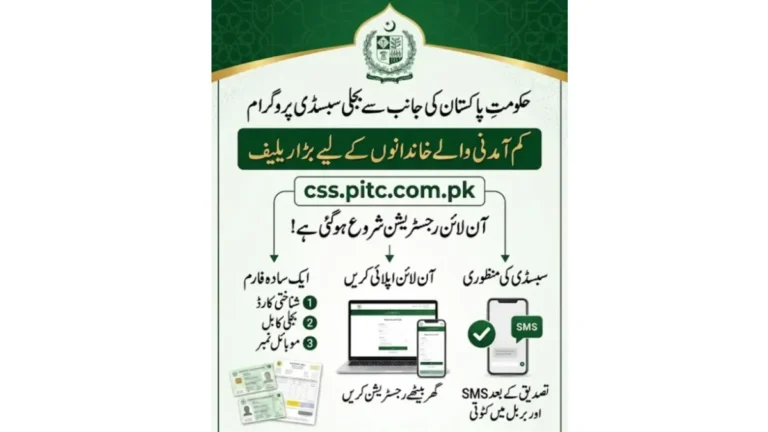
- Visit the official Punjab government solar scheme portal.
- Enter your CNIC number and the electricity reference number printed on your bill.
- Verification happens automatically — the system cross-checks your consumption data, connected load, and CNIC against DISCO records.
- Ballot entry — if you meet all criteria, your application enters the ballot system.
- Results are announced in phases; distribution is staggered across districts, so not all eligible applicants receive systems immediately.
Keep your CNIC and a recent electricity bill on hand — the reference number is a 14-digit code at the top of your bill.
Checking Your Application Status
Log back into the portal with your CNIC to see whether your application is under review, selected in the ballot, or pending distribution. SMS updates are also sent to the mobile number linked to your CNIC, so make sure it’s active.
Common rejection reasons: consumption above 200 units, connected load above 2kW, or a duplicate CNIC entry.
If you’re outside the free-scheme eligibility band and considering buying a system out of pocket, taxes matter more than panel price — see our breakdown of solar panel taxes in Pakistan (2026).
Limitations of the Free Scheme
The scheme is a meaningful step for the lowest-income households, but it’s worth understanding its real limits:
- Small capacity. A 550W system generates roughly 2–3 units per day — enough for a couple of ceiling fans and LED lights. It won’t run an air conditioner, a refrigerator full-time, a water pump, or heating.
- No net metering. These are standalone kits — unused generation is simply wasted, with no way to export surplus or offset nighttime use.
- Variable component quality. Government procurement at this scale prioritises cost, so panels and inverters aren’t the same Tier-1 components used in professionally engineered systems — expect shorter lifespans and faster degradation.
- No monitoring or maintenance. No ongoing performance monitoring, maintenance contract, or warranty support after installation.
- No battery storage. The system only works while the sun is out — evenings and nights still draw entirely from the grid.
None of this is a knock on the programme. For a household spending Rs. 1,000–2,000 a month on electricity, a free 550W kit that powers fans during the day is genuinely useful. It’s just important to know its limits.
When the Free Scheme Isn’t Enough
If your monthly bill exceeds Rs. 5,000, the free scheme wasn’t built for you. A 550W or even 1,100W kit won’t make a meaningful dent in a bill driven by air conditioning, refrigeration, and appliances running day and night.
The math is straightforward: a household consuming 500–800 units a month needs a 5kW–10kW system to meaningfully cut grid dependence — five to ten times the capacity of the government kit.
A properly engineered system at that scale includes net metering, so every unit you generate but don’t use gets exported to the grid and offsets your bill. Under current NEPRA prosumer regulations, self-consumed solar saves Rs. 55–65 per unit — which changes the payback math entirely.
The free scheme gives you a fan and a few lights. A full system gives you energy independence.
What Solar Citizen Offers Beyond the Government Scheme
We work with homeowners and businesses that need systems built to actually eliminate the electricity bill — whether you’ve outgrown what the CM Punjab scheme provides, or never qualified because your consumption was too high.
Our residential systems start at 5kW and scale to your load. Every installation includes:
- Tier-1 panels only — Jinko, LONGi, JA Solar, Canadian Solar, or Trina, serial-number verified, no exceptions
- Full engineering and design — load profile, roof orientation, shading, and consumption patterns analysed before we specify a single component
- Net metering support — we handle the DISCO application, bidirectional meter installation, and all paperwork to get your system grid-connected and earning credits
- SOL AI monitoring — real-time tracking of generation, consumption, and self-use ratio, flagging underperforming panels and maintenance issues
- Warranty and maintenance — structured aftermarket support, not a number that stops answering after installation day
The government scheme and a professionally installed system solve different problems for different households — both have a place. But if your goal is to stop paying LESCO, MEPCO, or FESCO tens of thousands of rupees a month, you need engineering, not a government kit.
If you want a system sized and built for your actual consumption, talk to our engineering team.
Related Reading
- Solar Financing and Installment Plans in Pakistan 2026
- Solar Panel Price in Pakistan Today (July 2026)
- What Size Solar System Do I Need?
[Estimate your system size first →]
By Mujtaba Raza — Founder & CEO, Solar Citizen; CEO, Modular Energy. PPIB-ranked #1 in Pakistan’s independent power producer category, AEDB C-2 licensed, and published 5x on solar policy in Dawn. Led engineering on the Supreme Court of Pakistan’s first federal solar installation.